

15 Vital Questions to Ask a Migration Agent Before You Apply (2026 Guide)
Published 1 September 2026 · 17 min read
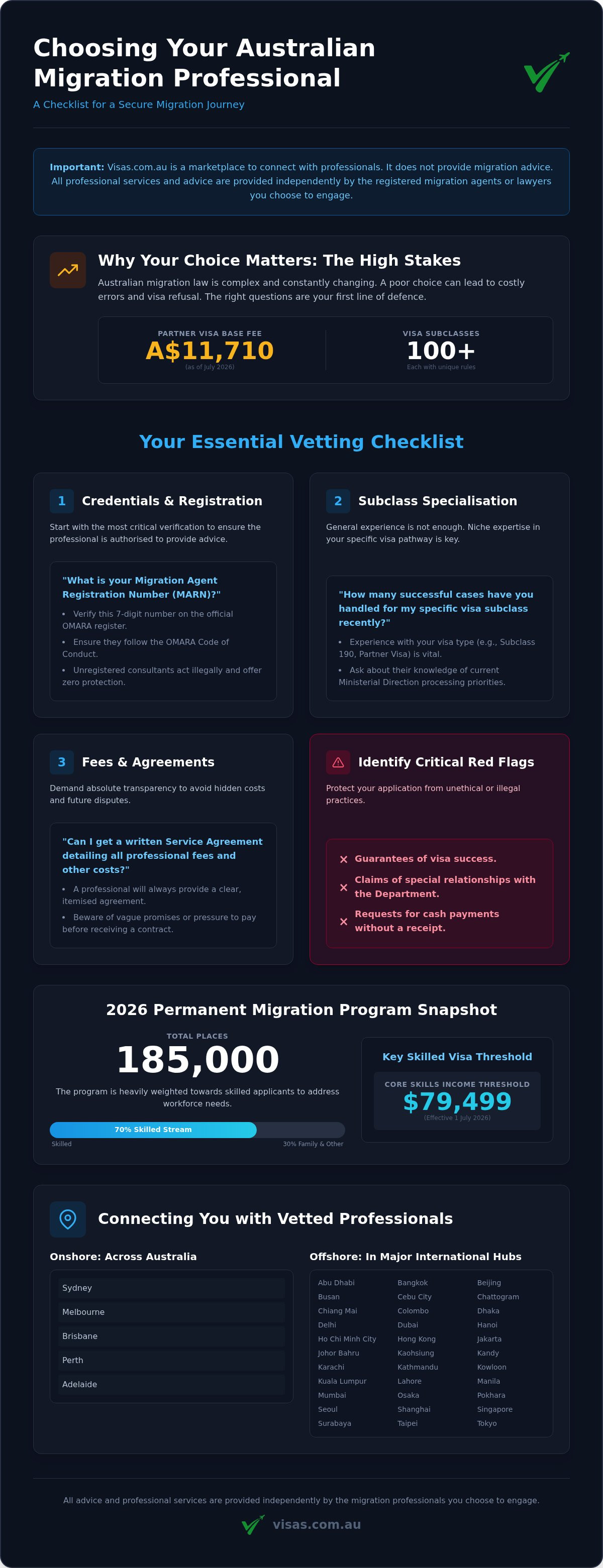
What if the success of your Australian dream depends less on your qualifications and more on the interview you conduct before signing a contract? With the base application charge for a Partner visa now reaching A$11,710 as of July 2026, the stakes have never been higher for those seeking a new life Down Under. It's completely natural to feel anxious about "ghost agents" or the threat of a visa refusal due to poor advice. Knowing the right questions to ask a migration agent is your first line of defence against scams and costly administrative errors.
We understand that navigating the 2026 Migration Agents Regulations can feel overwhelming, especially with the recent transition to the Administrative Review Tribunal (ART). You deserve a professional who offers absolute transparency, not hidden costs or vague promises. This guide provides a comprehensive checklist to help you master your initial consultation and choose a verified expert with confidence. We'll walk you through the essential enquiries regarding professional fees, MARA registration, and the latest processing priorities to ensure you remain in total control of your migration journey from the very first meeting.
Key Takeaways
- Identify the mandatory registration requirements and the latest 2026 regulations that ensure your chosen professional is authorised by the Australian government.
- Learn why subclass-specific specialisation is more critical than general years of experience when navigating the current Ministerial Direction processing priorities.
- Master the essential questions to ask a migration agent to ensure you receive a transparent, written Service Agreement with no hidden costs.
- Recognise critical red flags, such as guarantees of visa success or claims of special relationships with the Department, to protect your application from unethical practices.
- Understand how to use a verified marketplace to efficiently compare vetted, independent professionals who match your unique migration goals.
Table of Contents
Why Asking the Right Questions to a Migration Agent is Critical
Australian migration law is arguably one of the most volatile and complex legal frameworks in the world. With over 100 visa subclasses and frequent legislative shifts, such as the major fee increases implemented on 1 July 2026, the margin for error is non-existent. This is why your initial consultation must be treated as a high-stakes strategic assessment rather than a casual enquiry. Preparing targeted questions to ask a migration agent allows you to peel back the marketing layers and evaluate their actual legal competence before you commit your hard-earned savings.
In Australia, a Registered Migration Agent (RMA) is a government-authorised professional. They must adhere to the OMARA Code of Conduct, which was significantly strengthened by the Migration Agents Regulations 2026 on 1 April. This framework ensures you have consumer protection if things go wrong. An Immigration consultant operating without this registration is acting illegally and offers you zero protection against fraud or incompetent advice.
The Legal Baseline: Registration and Credentials
Your first question should always be, "What is your Migration Agent Registration Number (MARN)?" This seven-digit code is the key to their professional identity. Developing a list of specific questions to ask a migration agent is the best way to determine if they possess the required credentials. You should verify this number on the official OMARA register before your meeting begins. It's also vital to distinguish between an agent and an Australian immigration lawyer. While both can provide migration advice, a lawyer has a broader legal background and can represent you in court if your case goes beyond the Administrative Review Tribunal (ART).
The Value of Professional Migration Advice
Professional migration advice is a tailored strategy based on the specific provisions of the Migration Act 1958. A qualified expert does more than just fill in forms; they build a legal case for your residency. They identify pathways you might have missed, such as regional exemptions or the latest Core Skills Income Threshold requirements. An expert also navigates the complexities of Ministerial Direction 119, which prioritises applications based on your occupation and location. While Visas.com.au is a marketplace and not an advice provider, we ensure that the independent professionals you connect with through our platform are fully vetted. This transparency gives you the control to choose an expert who truly understands the nuances of your specific visa subclass.
Evaluating Specialisation and Visa Subclass Experience
Experience measured solely in years can be a misleading metric in the Australian migration landscape. A professional who has spent a decade processing Student visas might have very little insight into the rigorous evidentiary requirements of a Subclass 190 state nomination or a Subclass 143 Contributory Parent visa. When compiling your questions to ask a migration agent, focus on their recent track record with your specific subclass rather than their overall tenure. This is particularly vital in 2026, as the government has set the permanent migration program at 185,000 places with a strict 70:30 split favouring skilled applicants.
To ensure you receive accurate guidance, you should also look at international standards for vetting professionals. For example, many applicants find it helpful to choose an immigration or citizenship representative based on a structured interview process that prioritises specialisation. Gauging an agent's familiarity with recent policy shifts, such as the July 2026 income threshold increases, will quickly reveal whether they are staying current with legislative changes. If you want to ensure your chosen expert has the right niche expertise, you can register through our platform to compare verified professionals who specialise in your specific visa category.
Questions for Skilled and Employer-Sponsored Visas
For those pursuing skilled pathways, the technical requirements are unforgiving. You need to know if your agent understands the nuances of the Core Skills Income Threshold, which rose to $79,499 on 1 July 2026. Ask how many successful Subclass 189 or 190 applications they have handled in the current quota year. Inquire specifically about their experience with your relevant skills assessment authority, as each body has distinct criteria for work experience and qualification recognition. If you are looking at a Subclass 482 visa, ask how they manage labour market testing to ensure the $4,015 application charge isn't wasted on a non-compliant submission.
Questions for Family and Partner Migration
Family migration involves a heavy burden of subjective evidence. With Partner visa base charges now at $11,710, a refusal is a devastating financial blow. Ask what specific evidence they recommend for proving a de facto relationship in your unique circumstances. For onshore applicants, it's critical to include questions to ask a migration agent about 'Schedule 3' requirements if you don't currently hold a substantive visa. Inquire about the impact of Ministerial Direction 117 on your processing timeline, as onshore family applicants are now receiving the highest priority. These experts should be able to explain how they structure a case to meet the "genuine and continuing" criteria required by the Department.
The Commercials: Fees, Agreements, and Service Levels
The financial aspect of an Australian visa application often causes the most anxiety. In Australia, there's no official or uniform scale for professional fees. This means a senior agent in Melbourne might charge A$7,700 for a Partner visa, while another practice might quote A$2,500. When preparing your list of questions to ask a migration agent, you must demand a clear breakdown of how these fees are calculated and what exactly they cover. Case complexity, such as prior refusals or health waivers, will naturally increase the professional time required.
It's a legal requirement under the OMARA Code of Conduct for an agent to provide a written 'Agreement of Services' before any work commences. This document acts as a contract that protects your interests by outlining the specific scope of work and the agreed price. You should specifically ask: 'What is the total cost, including GST and Department of Home Affairs charges?' Understanding whether you are paying an upfront retainer or following a staged payment plan is crucial for your budgeting. Staged payments are often preferred as they align the agent's compensation with the completion of specific milestones, such as the successful submission of a skills assessment.
Transparency in Costs and Disbursements
Professional fees are only one part of the total investment. You must ask for a detailed breakdown of disbursements, which are external costs paid to third parties. These typically include medical examinations, police clearances, and mandatory translation services for non-English documents. In some cases, skills assessment fees or state nomination charges can add several thousand dollars to your total budget. A reputable professional will be transparent about these 'hidden' costs from the outset. Additionally, the OMARA Code of Conduct strictly regulates how your money is handled. Agents are generally required to hold your funds in a separate client bank account until the work is actually performed, providing an essential layer of financial security.
Communication and Case Management
The quality of your experience often depends on how well your case is managed on a daily basis. Don't hesitate to ask: 'Who will be my primary point of contact and how often will I receive updates?' It's common for senior agents to handle the initial strategy while administrative staff manage the documentation. You need to know exactly who is responsible for your file. Clarify expected response times for emails and phone calls to avoid the frustration of being left in the dark during critical processing periods. If you are ready to begin this process, you can Connect with Migration Professionals in Australia Today to find an expert who matches your communication preferences.
Identifying Red Flags and Protecting Your Application
Protecting your future in Australia requires more than just submitting forms; it demands a vigilant approach to who you trust with your case. The 2026 Migration Agents Regulations have significantly increased the penalties for unethical conduct, yet 'ghost agents' continue to target vulnerable applicants. When preparing your questions to ask a migration agent, include queries that test their integrity. A reputable professional will always prioritise the law over a quick result.
The first and most critical red flag is any guarantee of visa success. No agent or lawyer can promise a specific outcome, as the final decision rests solely with the Department of Home Affairs. Similarly, be extremely cautious of anyone claiming to have a 'special relationship' or an 'inside track' with departmental staff. These claims are fraudulent and violate the professional Code of Conduct. Financial transparency is another safeguard. Always ensure your payments are made to a registered business account rather than a personal one, and insist on a formal tax invoice for every transaction.
The Risk of 'Ghost Agents'
Ghost agents are individuals who provide migration advice without being registered with the Office of the Migration Agents Registration Authority (OMARA). Operating outside the law, these individuals offer no consumer protection. If the Department discovers you have used an unregistered agent, your application could be refused, and you may face a permanent visa ban under strict integrity rules. If you encounter suspicious activity, you should report it to OMARA or the Administrative Review Tribunal (ART) immediately. To avoid these risks entirely, you can register with our marketplace to connect with professionals who have already passed our rigorous vetting process.
Managing Expectations and Potential Refusals
A truly professional advisor will be honest about the hurdles you face. Ask: 'What are the specific risks or weaknesses you see in my application?' If an agent refuses to discuss the possibility of a refusal, they are not acting in your best interest. You should also inquire about their experience with the Administrative Review Tribunal (ART), which replaced the old appeals system. As of 2026, the application fee for most migration reviews is A$3,727. Knowing your agent can handle a complex appeal provides an extra layer of security. We also offer resources for migration professionals to help them maintain these high standards of service.
How to Compare and Choose the Right Professional for You
Selecting the right expert for your Australian visa application shouldn't be a matter of chance. While searching a government register provides a list of names, it doesn't give you the tools to compare service quality or value between different practices. A marketplace model offers the most efficient way to vet multiple professionals by allowing you to review their specific experience and fee structures side-by-side. Visas.com.au serves as a facilitator in this process, connecting you with independent, verified experts who are already vetted for their credentials and professional standing.
By receiving multiple proposals, you gain a clearer perspective on current market rates and the distinct strategic approach each professional suggests for your case. This process empowers you to use your list of questions to ask a migration agent to filter for the best possible partner. It's vital to remember that while our platform handles the enquiry management, all migration advice is provided independently by your chosen professional, ensuring you receive a personalised strategy tailored to your unique circumstances.
Onshore Support Across Australia
For those already living in Australia, local knowledge is often the deciding factor in a successful application. We connect you with experts in Sydney, Melbourne, Brisbane, Perth, and Adelaide who understand the specific nuances of state-nominated visa pathways. These professionals can manage face-to-face consultations or digital engagements, depending on your preference. Having a representative who understands the local labour market and state-specific requirements can be a significant advantage when navigating the 2026 processing priorities.
Offshore Connections for International Applicants
Our platform supports applicants from major global hubs, ensuring distance isn't a barrier to professional advice. We serve seekers in Beijing, Shanghai, Mumbai, Delhi, and Manila. Our network also extends to applicants in Cebu City, Ho Chi Minh City, Hanoi, Jakarta, and Surabaya. Whether you are in Kuala Lumpur, Johor Bahru, Bangkok, Chiang Mai, Seoul, or Busan, you can connect with professionals who understand the specific documentation requirements of your region. This global connectivity ensures that regardless of where you are starting your journey, you have access to the same high standard of professional verification.
Next Steps: Registering Your Enquiry
The first step toward a successful outcome is providing a clear job description. By detailing your current visa status, your goals, and any potential complications, you attract the most relevant migration professionals. This transparency allows experts to provide more accurate proposals from the start, as they can tailor their responses to your specific needs. The process of submitting your requirements via the Visas.com.au platform is simple and designed to give you total control over the selection process. Register your migration enquiry today to connect with verified professionals and begin your journey with confidence.
Securing Your Australian Future with Confidence
You now possess the framework required to distinguish between a "form-filler" and a strategic legal partner. By preparing these specific questions to ask a migration agent, you've taken the most important step in protecting your significant financial investment and avoiding the pitfalls of ghost agents. Navigating the 2026 regulatory environment requires a professional who is not only registered but also deeply specialised in your specific visa subclass.
The right expert will transform a complex legal process into a manageable, structured journey. Connect with verified Australian migration experts at Visas.com.au today to begin your assessment. Our platform provides a secure enquiry management system for both onshore and offshore applicants, allowing you to access a network of vetted RMAs and immigration lawyers. You can compare multiple professional quotes tailored to your unique case, ensuring you find the right fit for your migration goals. Your journey to Australia is a significant undertaking; choosing a verified professional ensures your path remains clear, compliant, and well-managed.
Frequently Asked Questions
Is it worth hiring a registered migration agent in 2026?
Hiring a professional is highly recommended given the current volatility of Australian migration law. With the base Partner visa charge rising to A$11,710 in July 2026, the financial risk of an error is significant. Registered agents provide essential protection under the OMARA Code of Conduct and ensure your strategy aligns with the latest Ministerial Directions. They manage the complex documentation required to meet strict evidentiary standards, which is often the difference between a grant and a refusal.
How much does a migration agent typically cost for a partner visa?
Indicative professional fees for a Partner visa in 2026 typically range from A$2,500 to A$7,700. These fees are entirely separate from the A$11,710 government application charge. The final cost depends on your case complexity, such as whether you require a health waiver or have a complicated visa history. You should always request a written 'Agreement of Services' that outlines all professional costs and potential disbursements before any work on your application begins.
Can a migration agent guarantee that my visa will be approved?
No migration agent or lawyer can guarantee a successful visa outcome. The power to grant a visa rests solely with the Department of Home Affairs. Any claim of a guaranteed approval or a "special relationship" with Department staff is a major red flag and a breach of professional conduct. A reputable expert will instead provide a candid assessment of your application's strengths and weaknesses, helping you mitigate risks before you submit your documents.
What is the difference between a migration agent and an immigration lawyer?
Registered Migration Agents (RMAs) are authorised by the government to provide migration advice and must be registered with OMARA. Australian immigration lawyers are legal practitioners who can also provide migration advice but have broader legal training. Lawyers are also qualified to represent clients in court proceedings if a case escalates beyond the Administrative Review Tribunal (ART). Both professionals are required to provide high-quality independent advice and maintain strict standards of consumer protection.
How do I check if a migration agent is truly registered with OMARA?
You can verify registration by searching for an agent's seven-digit Registration Number (MARN) on the official OMARA website. Verifying these credentials is one of the most critical questions to ask a migration agent during your initial meeting. Using an un-registered "ghost agent" is illegal in Australia and leaves you with no legal recourse if your money is stolen or if your application is refused due to incompetent or fraudulent advice.
What should I do if my migration agent stops responding to my emails?
If your agent stops responding, first check your service agreement for established communication protocols. Send a formal follow-up email and keep a record of all attempts to contact them. If the silence persists, you can lodge a formal complaint with OMARA for a breach of the Code of Conduct. They have the authority to investigate professional misconduct and can take disciplinary action against agents who fail to meet their management and communication obligations.
Can I change my migration agent if I am unhappy with their service?
You are free to change your agent at any time if you are dissatisfied. You must notify the Department of Home Affairs by submitting Form 956 to cancel their authority to act on your behalf. Before switching, review your contract regarding refunds for unearned fees. Using a marketplace like Visas.com.au is an efficient way to find a new vetted professional in cities like Sydney, Perth, or offshore hubs like Manila and Mumbai.
What happens if my visa is refused while I am using a professional?
If a refusal occurs, your agent should provide a detailed analysis of the Department's decision and outline your review options. Most migration refusals can be appealed to the Administrative Review Tribunal (ART), which requires a specific application fee of A$3,727 as of 2026. This is why including questions to ask a migration agent about their experience with the ART is vital during your first consultation to ensure they can handle complex appeals.
Disclaimer
Nothing in the article is intended to be providing any migration or legal advice whatsoever and this website Visas.com.au is a marketplace and does not itself provide migration advice or legal services. All advice and professional services are provided independently by the migration professionals you choose to engage.
Frequently asked questions
This article is general information only and is not migration, legal or personal advice. Visas.com.au is a marketplace and does not provide migration or legal services. For advice about your circumstances, engage a registered migration agent or Australian immigration lawyer.