
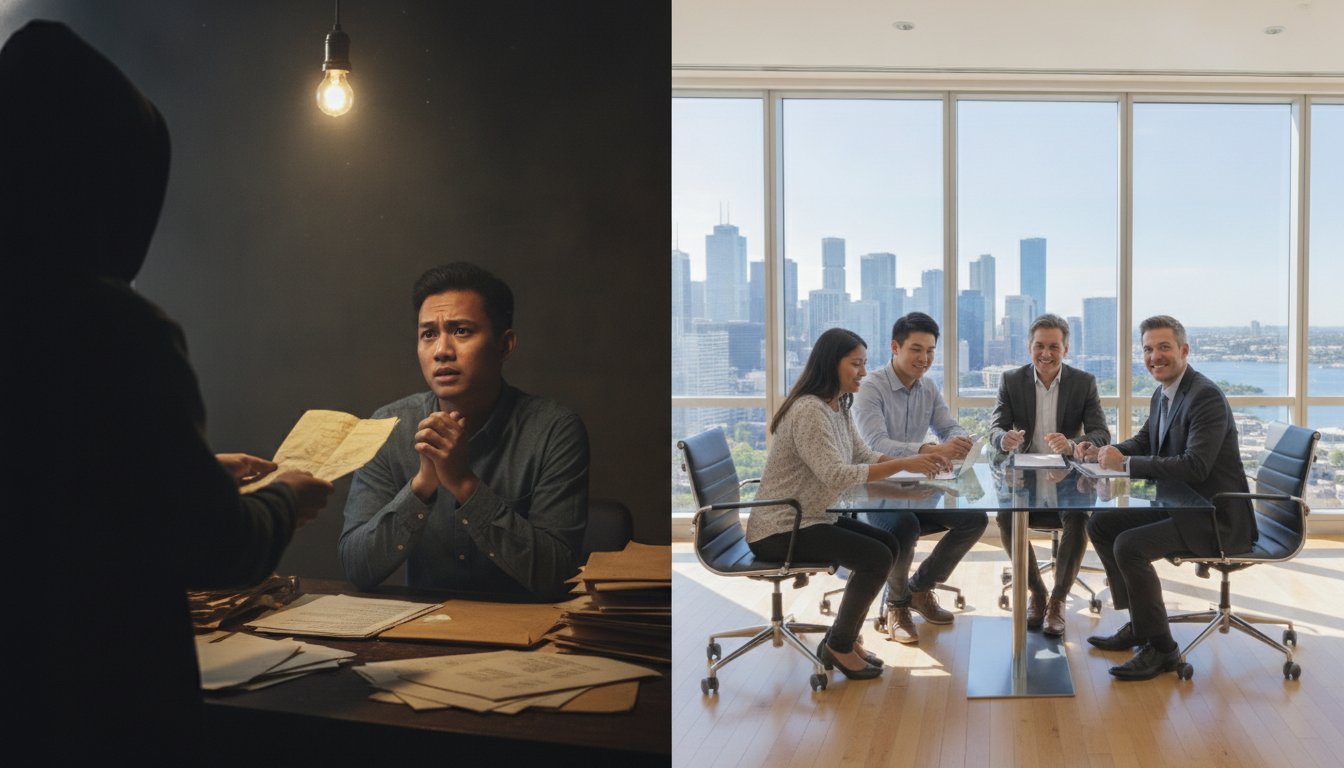
Dangers of Unregistered Migration Agents: The 2026 Safety Guide
Published 4 September 2026 · Updated 6 September 2026 · 17 min read
Imagine transferring your life savings from a bank in Mumbai or Ho Chi Minh City to a consultant who promises a guaranteed visa, only to discover they've vanished along with your hopes of a new life. This nightmare is a reality for many who fall victim to the dangers of unregistered migration agents, often called 'ghost agents', who exploit the complexity of the Australian immigration system for personal gain. With the 1 April 2026 regulatory updates introducing significantly stricter penalties and a new infringement notice framework, the risks of engaging an unverified operator have never been higher for your future.
It's understandable to feel overwhelmed by the fear of visa cancellations or the confusion between registered agents and immigration lawyers. You deserve a migration process defined by transparency and legal integrity rather than uncertainty. This guide provides a foolproof framework to identify legitimate professionals and verify their credentials through a secure vetting process. We will examine the latest OMARA enforcement trends, explain how to spot 'front agent' traps, and show you how the Visas.com.au marketplace acts as a protective layer by connecting you with independent, pre-vetted experts who prioritise your security and success.
Key Takeaways
- Learn why the evolution of 'ghost agents' in 2026 has increased the dangers of unregistered migration agents, potentially leading to permanent visa bans under Section 4020.
- Discover how to instantly spot fraudulent behaviour by identifying unrealistic 'guaranteed' outcomes and the use of unofficial communication channels like WhatsApp.
- Understand the legal boundaries of 'immigration assistance' as defined by the Migration Act 1958 and the critical oversight role played by the OMARA.
- Master a practical verification framework to cross-reference professional credentials against official government registers before making any financial commitments.
- Find out how using a vetted marketplace provides an essential security layer by connecting you exclusively with independent, pre-verified migration experts.
Table of Contents
The Rising Dangers of Unregistered Migration Agents in 2026
The Australian migration landscape underwent a significant shift on 1 April 2026 with the commencement of the Migration Agents Regulations 2026. While these laws were designed to strengthen the industry, 'ghost agents' have responded by becoming more sophisticated. Modern fraudsters now use generative AI to produce highly convincing, yet entirely fraudulent, Department of Home Affairs letterheads and visa grant notices. The primary dangers of unregistered migration agents in this new era involve their ability to operate entirely in the digital shadows, leaving applicants with no legal trail when their money disappears.
Engaging an unverified operator carries a high risk of triggering a 'Section 4020' ban. This regulation allows the Department to refuse a visa and impose a ten-year ban if an applicant provides false or misleading information, even if they were unaware that their agent had falsified the documents. Beyond the loss of your Australian dream, there's a total lack of financial protection. Registered professionals must hold professional indemnity insurance, whereas unregistered scammers offer no such safety net. If your A$15,000 deposit is stolen, there's no insurance body to compensate you. Understanding what is a migration agent in the Australian context is the first step toward safety; they are legally required to be registered with the OMARA to provide any form of immigration assistance.
Targeting Global Migration Hubs
Offshore applicants are currently facing a surge in coordinated scams. In Manila, Mumbai, and Ho Chi Minh City, fraudsters often set up physical offices branded as 'Australian Visa Information Centres' to mimic official government buildings. These operators frequently sell 'guaranteed' job-visa packages in Kuala Lumpur and Jakarta, claiming to have exclusive deals with Australian employers. These packages are almost always non-existent, designed solely to harvest large upfront payments from hopeful families before the 'agent' deactivates their contact details.
Onshore Risks in Sydney and Melbourne
The threat isn't limited to those outside Australia. In major cities like Sydney and Melbourne, scammers exploit the anxiety of bridging visa holders through social media platforms. We've seen a rise in 'influencer' agents who use short-form video content to spread misinformation about 'secret' visa pathways or upcoming amnesties that don't exist. Providing unregistered assistance is a criminal offence under the Migration Act 1958. To ensure your application remains valid, it's vital to use a secure marketplace like Visas.com.au, which connects you with independent, pre-vetted professionals who are fully authorised to provide advice.
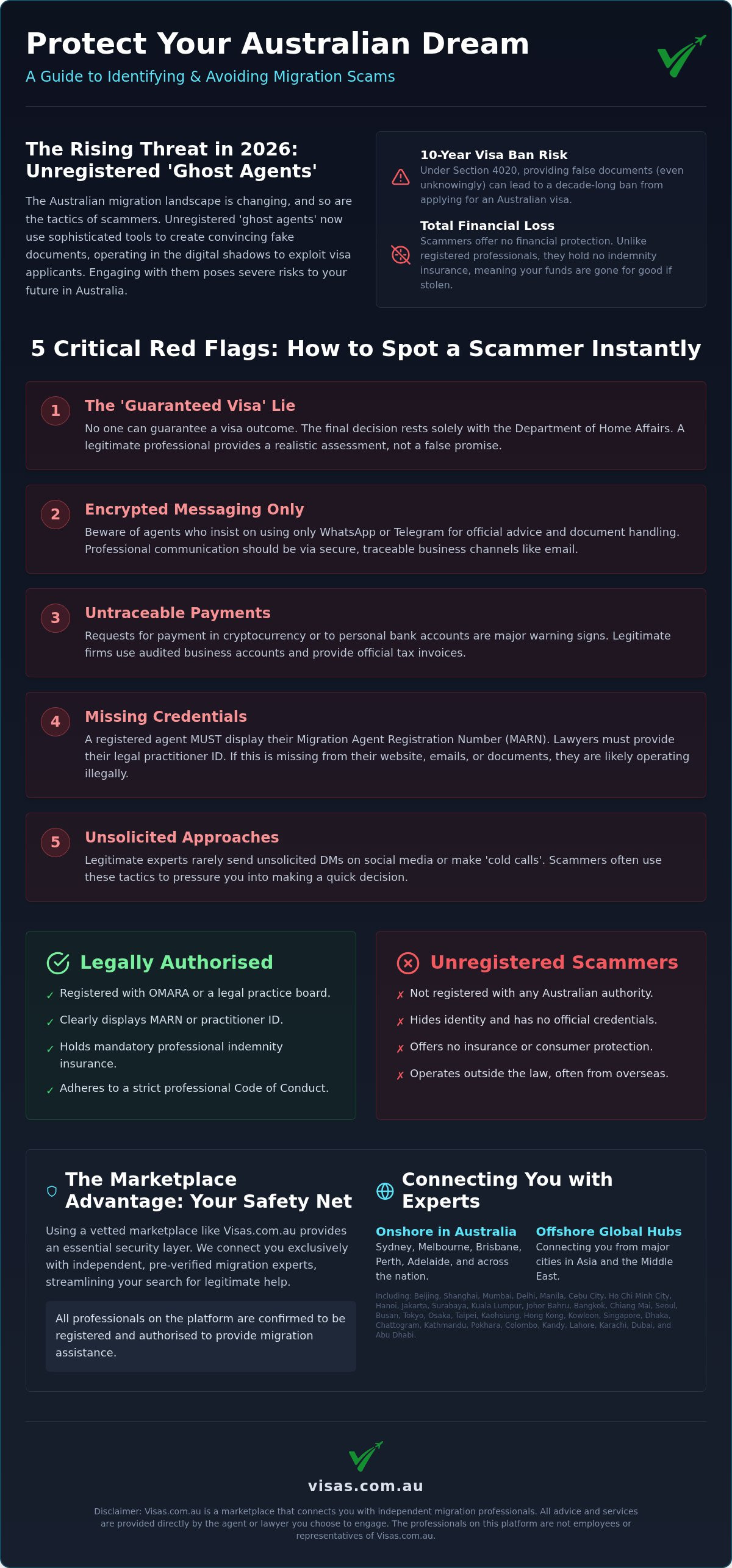
5 Critical Red Flags: How to Spot a Scammer Instantly
Identifying the dangers of unregistered migration agents starts with recognising specific patterns of behaviour that deviate from Australian legal standards. Legitimate professionals operate within a strict regulatory framework that prioritises transparency and consumer protection. If you encounter any of the following five red flags, you should cease communication immediately to protect your funds and your future in Australia.
- The 'Guaranteed Visa' Lie: No agent or lawyer can guarantee an outcome. The final decision rests solely with the Department of Home Affairs. A professional provides a realistic assessment based on current 2026 policy, not a sales pitch.
- Encrypted Messaging Only: Be wary of anyone insisting on using apps like WhatsApp or Telegram for all official business. While these are convenient for quick chats, formal advice and document handling should occur through secure, traceable business channels.
- Untraceable Payments: Requests for payments in cryptocurrency or transfers to personal bank accounts are major warning signs. Legitimate firms use audited business accounts and provide formal tax invoices for every transaction.
- Missing Credentials: Every authorised professional must display their Migration Agent Registration Number (MARN) or Australian Legal Practitioner ID. If this is missing from their website or email signature, they're likely operating illegally.
- Unsolicited Approaches: Legitimate experts rarely 'cold call' or send unsolicited direct messages on social media to offer visa services.
Digital Red Flags in the 2026 Landscape
The rise of generative AI has made it easier for scammers to create fraudulent grant letters that look authentic at first glance. Always check the sender's email address. Professional organisations use their own domains, whereas scammers often rely on generic services like @gmail.com or @outlook.com. Additionally, be cautious of 'budget' fees. If a quote is significantly lower than the market average, it often indicates the agent isn't paying for mandatory registration or professional insurance, leaving you completely exposed if things go wrong.
Pressure Tactics and Lack of Contracts
Scammers rely on artificial urgency to bypass your critical thinking. They might claim a 'limited time' visa window is closing to force an immediate payment. A real professional encourages you to review a written Service Agreement before any funds change hands. This contract is a legal requirement that outlines the scope of work and fee structure. When checking reviews, look for specific details about the migration process. Generic, repetitive praise often signals bot-generated testimonials designed to mask the dangers of unregistered migration agents.
To ensure you're working with a legitimate expert, you can register your enquiry through our secure marketplace to be connected with pre-vetted professionals who prioritise your security.
Legally Protected: Who Can Provide Migration Advice?
The Australian migration system is built on a foundation of strict legal definitions designed to protect applicants from fraud. Under the Migration Act 1958, 'immigration assistance' is defined as using special knowledge of migration law to help someone with a visa application or a tribunal matter. This is not a task for well-meaning friends or social media consultants. To mitigate the dangers of unregistered migration agents, the law restricts this assistance to specific, qualified individuals who are accountable to Australian regulatory bodies.
The Office of the Migration Agents Registration Authority (OMARA) acts as the primary regulator for the industry. While Visas.com.au serves as a marketplace to help you connect with these experts, we operate as a secure gateway rather than a provider of advice. It's essential to understand the 'Independent Professional' rule: your formal service agreement and legal contract are with the individual migration professional you select, not the platform. This direct relationship ensures that the expert is personally liable for the accuracy and integrity of your application.
Migration Agents vs. Immigration Lawyers
Both Registered Migration Agents (RMAs) and Australian legal practitioners are authorised to provide migration help, but they operate under different regulatory frameworks. RMAs are specialists who have completed specific postgraduate study in migration law. Immigration lawyers are admitted to the Australian legal profession and can often handle more complex litigation in the Federal Court. To ensure you aren't falling for a scam, you should always verify credentials using the official OMARA register or the relevant state Law Society. For more details on this process, see our guide on How to Check Migration Agent Credentials in Australia: A 2026 Step-by-Step Guide.
The Protection of the Code of Conduct
When you hire a registered professional, you're protected by a mandatory Code of Conduct. This isn't just a set of suggestions; it's a legal requirement that governs everything from how they communicate to how they handle your money. Only OMARA-registered agents or lawyers can legally charge for migration help. Registered professionals must hold professional indemnity insurance and use dedicated client fund accounts to keep your A$ deposits separate from their business expenses. This financial transparency is the most effective way to avoid the dangers of unregistered migration agents, who often demand untraceable cash payments and offer no recourse if your application is mishandled.
The 2026 'Safe Hire' Checklist for Visa Applicants
While checking a registration number is a vital first step, it doesn't always reveal the operational integrity of a business. To fully insulate yourself from the dangers of unregistered migration agents, you need a structured vetting process that goes beyond a simple ID check. This checklist ensures that the professional you choose is not only registered but also operates with the transparency required by Australian law.
- Step 1: Cross-reference credentials. Take the Migration Agent Registration Number (MARN) or Legal Practitioner ID and search it directly on the official OMARA or state Law Society website. Ensure the status is 'Active' and the name matches your contact.
- Step 2: Test their 2026 policy knowledge. During your initial talk, ask how the April 2026 regulatory changes affect your specific visa pathway. A legitimate expert will be well-versed in the new infringement notice framework.
- Step 3: Demand a written Service Agreement. Never pay a cent until you've received a formal contract. This document must clearly outline the scope of work, the total A$ fee, and the expected timeline.
- Step 4: Verify a physical presence. Even if you're applying from overseas, check that the firm has a verified office address in a major centre like Brisbane, Perth, or Seoul. Fraudsters often rely on vague, virtual-only identities.
- Step 5: Use a vetted marketplace. Platforms like Visas.com.au act as a security layer by pre-vetting professionals, ensuring every expert you connect with has already passed a rigorous verification process.
Interviewing Your Potential Professional
The consultation is your opportunity to gauge expertise. If an agent gives vague answers or avoids technical details about your visa subclass, such as the 189, 190, or 820, it's a significant warning sign. You should prepare a list of specific queries to test their competency. For a comprehensive list of what to ask, read our guide on 15 Vital Questions to Ask a Migration Agent Before You Apply (2026 Guide). A professional won't be offended by your due diligence; they'll appreciate your commitment to a lawful process.
Securing Your Financial Transactions
Financial transparency is the best defence against the dangers of unregistered migration agents. Always insist on a formal tax invoice and a corresponding receipt for every payment made. You should only use traceable bank transfers to Australian-based business accounts. Be particularly wary of 'admin fee' scams where an operator asks for a small, urgent payment to 'unlock' a government file. Legitimate government charges are clearly listed on the Department of Home Affairs website and are typically paid through your agent's audited client account.
To start your journey with a professional you can trust, you can submit your migration enquiry here and receive connections to pre-vetted, independent experts.
How Visas.com.au Streamlines Your Search for Legitimate Help
Finding a trustworthy professional shouldn't be a gamble. While the dangers of unregistered migration agents continue to evolve in 2026, our platform provides a structured solution to secure your Australian future. Visas.com.au operates as a marketplace facilitator, acting as a bridge between visa applicants and independent, verified experts. We don't provide migration advice ourselves; instead, we offer a secure environment where you can connect with professionals who have already cleared our rigorous vetting standards.
The marketplace model is built on transparency and choice. When you submit an enquiry, our system identifies your specific needs and notifies relevant, registered experts. You'll receive multiple quotes from independent agents and lawyers, allowing you to compare their experience and fee structures without pressure. By acting as a quality gatekeeper, we ensure that every responder is a legitimate professional with an active registration. This approach removes the guesswork and helps you avoid the 'ghost agent' traps that often target unassisted seekers.
Connecting Global Applicants with Australian Expertise
Whether you're an offshore seeker in Bangkok, Hong Kong, or Singapore, or an onshore applicant looking for local migration lawyers in Adelaide or Melbourne, our network covers the full spectrum of Australian migration law. We understand that distance can make verification difficult. That's why we've built a system that bridges the gap between global ambition and local regulation. You can Connect with Migration Professionals in Australia Today through our platform, ensuring your first step is a safe one.
Taking the Next Step Safely
Starting your migration journey with us is straightforward. You simply provide the details of your situation, and we handle the complex task of finding the right experts to review your case. This allows you to focus on your personal preparations while we manage the professional connections. For migration experts who are committed to maintaining high industry standards and are seeking quality clients, you can visit Visas.com.au for Professionals to learn more about our verification requirements.
Your Australian dream is too valuable to risk on an unregistered operator. The dangers of unregistered migration agents are real, but they are entirely avoidable with the right framework. By choosing a pre-vetted marketplace, you're not just finding an agent; you're investing in the peace of mind that comes from knowing your application is in the hands of a legitimate, accountable professional. Don't let a 'ghost agent' jeopardise your future when verified help is only an enquiry away.
Secure Your Australian Future with Verified Expertise
Professional registration isn't just a legal requirement; it's your primary defence against migration fraud. The 2026 regulatory environment demands higher vigilance from applicants than ever before. You now have the essential tools to spot red flags, from 'guaranteed' outcomes to untraceable payment requests. By following a structured vetting process and insisting on a formal Service Agreement, you protect yourself from the dangers of unregistered migration agents and the devastating risk of permanent visa bans.
Choosing the right professional shouldn't be a source of anxiety. Our platform provides marketplace transparency and choice, allowing you to compare multiple independent quotes from experts who have already cleared our rigorous vetting standards. This ensures you receive independent professional advice tailored to your unique circumstances. Secure your Australian future—register to connect with verified professionals today and move forward with the confidence that your dream is in safe, capable hands. Australia is waiting, and we're here to help you find the legitimate path to get there.
Frequently Asked Questions
Can someone guarantee me an Australian visa if I pay extra?
No legitimate professional can ever guarantee a visa outcome, regardless of the fee you pay. The Department of Home Affairs holds sole authority over approvals. If someone asks for extra money to ensure a result, they are likely a fraudster. One of the primary dangers of unregistered migration agents is their use of false promises to extract funds. A registered expert provides a realistic assessment based on 2026 migration law rather than empty guarantees.
How do I check if a migration agent is registered in 2026?
You can verify a professional's credentials by searching the official Register of Migration Agents on the OMARA website. In 2026, every registered agent must have an active Migration Agent Registration Number (MARN). If you're dealing with an Australian legal practitioner, you should check the relevant state Law Society register. Using a marketplace like Visas.com.au also helps, as we pre-vet every independent expert before they can connect with you on our platform.
What should I do if I think I have been scammed by a visa agent?
If you suspect you've been scammed, you should stop all payments and contact immediately. Report the individual to the Office of the Migration Agents Registration Authority (OMARA) and the Australian Competition and Consumer Commission (ACCC) via Scamwatch. If you're onshore in a city like Melbourne or Sydney, contact your local police. Prompt reporting is essential to protect others from the dangers of unregistered migration agents and to document the incident for your own records.
Is it illegal to use a migration agent who is not registered in Australia?
It is a criminal offence under the Migration Act 1958 for an unregistered person to provide immigration assistance for a fee in Australia. While the applicant isn't typically charged with a crime, using an unregistered operator puts your entire future at risk. The Department of Home Affairs may refuse your application or issue a permanent ban if the 'agent' provides fraudulent documents, making the choice of a registered professional a vital safety requirement for your journey.
What is the difference between a migration agent and a 'ghost agent'?
A registered migration agent is a qualified professional who is legally authorised and accountable to the OMARA. A 'ghost agent' is an unregistered individual who operates in the shadows, often refusing to sign your application or appearing as a 'friend' on official forms. These operators are dangerous because they lack professional indemnity insurance and don't follow the mandatory Code of Conduct, leaving you with no legal protection or financial recourse if your application is mishandled.
Do I need a lawyer for my Australian visa application?
You aren't legally required to hire a lawyer, but you must ensure your representative is either a registered migration agent or a qualified Australian legal practitioner. Lawyers often handle complex litigation or appeals in the Federal Court, while migration agents are specialists in visa subclasses and policy. Both are regulated and capable of providing high-quality assistance. Our marketplace allows you to compare quotes from both types of independent professionals to find the right fit for your specific needs.
Can a scammer use a real agent’s MARN number?
Scammers frequently engage in 'front agent' arrangements or identity theft by using a legitimate agent's MARN without their permission. To avoid this, don't just check the number; verify that the email address and office location match the details listed on the official OMARA register. If you're contacted by someone claiming to be an agent but using a generic email account or a different phone number, it's a major red flag for potential impersonation or fraud.
Why do scammers target specific cities like Manila or Mumbai?
Cities like Manila, Mumbai, and Ho Chi Minh City are targeted because they are major hubs for Australian migration with high volumes of applicants. Scammers exploit the distance between offshore seekers and Australian authorities, assuming that victims won't know how to verify credentials. They often set up fake centres to appear official. By using a secure platform like Visas.com.au, you can connect with verified professionals regardless of your location, ensuring you receive legitimate advice from the start.
Disclaimer
Nothing in the article is intended to be providing any migration or legal advice whatsoever and this website Visas.com.au is a marketplace and does not itself provide migration advice or legal services. All advice and professional services are provided independently by the migration professionals you choose to engage.
Frequently asked questions
This article is general information only and is not migration, legal or personal advice. Visas.com.au is a marketplace and does not provide migration or legal services. For advice about your circumstances, engage a registered migration agent or Australian immigration lawyer.